 Back
Back
Paul Van Hoeydonck

Paul Van Hoeydonck (1925–2025), became a pivotal figure in the post-war avant-garde. As co-founder of the G58 group, he broke with traditional forms and sought new ways to picture the world. From the 1960s onwards, Van Hoeydonck achieved international recognition with his Space Art. He conjured visions of galaxies, robots and orbital cities with a fascination for both utopia and emptiness.
Early in his career, he began experimenting with glass and plexiglass, materials whose reflections and light-play made the viewer part of the work. His celebrated white world was never a sterile void, but a charged field where light and darkness collide. The theme runs back to his first monochrome canvases of the 1950s.
Van Hoeydonck is known for being the only artist whose work is exhibited on the moon. During the Apollo 15 mission, astronaut David Scott placed Fallen Astronaut , 1971— an aluminium figure just 8.5 cm tall — on the lunar surface. It was carried as a tribute to the fourteen astronauts and cosmonauts who had lost their lives in the early years of space exploration. Yet it was never intended as a mere memorial. Van Hoeydonck wanted to create a universal emblem of humanity: a figure without nationality, without gender.
He once summed it up with striking clarity: “Amid all the technological debris left behind in space, this is the only trace of human art.”
Items

Fallen Astronaut, 2006
Paul Van Hoeydonck
Fallen Astronaut, 1971
Paul Van Hoeydonck
Kunst op de Campus #7: Paul Van Hoeydonck & Ernest Van Buynder
Paul Van Hoeydonck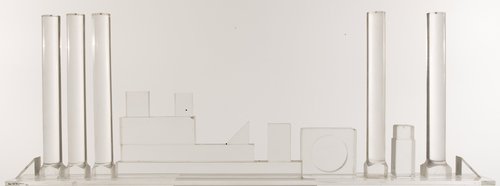
City of the Future, 1969
Paul Van Hoeydonck
Spaceman, 1965
Paul Van Hoeydonck
Reliëf - Maanlandschap, 1962
Paul Van Hoeydonck
Plexireliëf, 1960
Paul Van Hoeydonck![Lichtwerk [Lightwork]](https://s3.amazonaws.com/mhka_ensembles_production/assets/public/000/012/893/medium_500/Paul_Van_Hoeydonck__Lightwork__1960__plexi_assemblage.jpg?1350045625)
Lichtwerk [Lightwork], 1960
Paul Van Hoeydonck![Nebulus [Nebuleuse]](https://s3.amazonaws.com/mhka_ensembles_production/assets/public/000/094/511/medium_500/Paul_Van_Hoeydonck.jpg?1753447885)
Nebulus [Nebuleuse], 1960
Paul Van Hoeydonck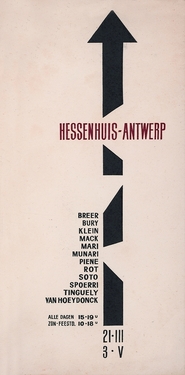
Vision in Motion / Motion in Vision, 1959
Paul Van Hoeydonck, Jean Tinguely, Jesús Rafael Soto, Dieter Roth, Bruno Munari, Heinz Mack, Yves Klein, Pol Bury, Robert Breer, Daniel Spoerri
Embedded Cities, 1958
Paul Van Hoeydonck![Lichtwerk [Work of light]](https://s3.amazonaws.com/mhka_ensembles_production/assets/public/000/009/306/medium_500/pvh_lichtwerk.jpg?1337008638)
Lichtwerk [Work of light], 1958
Paul Van Hoeydonck
Initiatieven, 1958
Jef Verheyen, Guy Vandenbranden, Paul Van Hoeydonck, Bert De Leeuw, Galerie Accent (Antwerpen)
Compositie 888, 1957
Paul Van Hoeydonck
Back