Gordon Matta-Clark — Museum in Motion

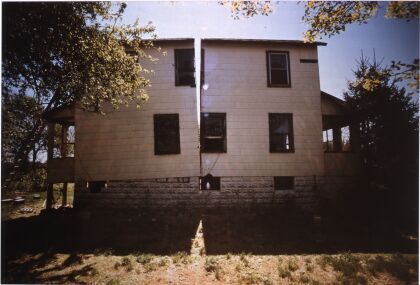
Gordon Matta-Clark (1943–1978) described his activities as 'anarchitecture' – a synthesis of the concepts of anarchy and architecture. Anarchitecture fuses a critique of the institutionalisation of culture, a direct engagement with one’s environment, and a preference for physical action. His rather irreverent site-specific interventions combined the formal language of minimalism with the large scale of land art. By making incisions into buildings, the interior and structure of a building were exposed, becoming readable in a new way. His art broke with traditional spatial perspective – there no longer being a centre, no top and bottom, and no inside and outside. The radicality of Matta-Clark’s interventions can be seen as a comment not only on architecture, but also on property speculation, exclusivity, and the commercialisation of the art world. A conceptual idealist, he was at the same time concerned with conviviality, creating working and meeting spaces in the urban environment.
The history of M HKA begins with the ICC, the International Cultural Centre in Antwerp. In 1977, Matta-Clark was invited by the ICC to realise the the magisterial project Office Baroque at the site of a former office block on Ernest Van Dijckkaai. After Matta-Clarke’s death the following year, and the establishment of the Gordon Matta-Clark Foundation, a major new museum project was developed around Office Baroque that, although failed, the fallout nevertheless laid the foundation for the M HKA collection.
Items
A Jacob's Ladder. Remembering Gordon Matta Clark., 1977
Aquisition on behalf of the Flemish Community. This original so far unused footage colour images and sound is digitised and digitally edited and post produced in 2012 and 2013. It concerns movie images and sound testimony’s and interviews who where captured by Cherica Convents around the art project “Jacob’s Ladder” performed by Gordon Matta-Clark in June 1977 during Documenta 6 in Kassel.
Shown as a part of a compilation in Documenta 5, 1973.