The ICC archives have preserved the material from two early works by ANTONI MUNTADAS (1942), a highly-esteemed figure in international art history and one of the artists of the neo-avant-garde who make politics an explicit theme.
His sizeable installation entitled N/S/E/O asks that we look at the world in a different way from the prevailing one. It was also a symbolic installation at the 1976 Venice Biennale, just before Muntadas’ solo exhibition at the ICC. In consultation with the artist, the work is now being set up again for the first time in thirty-five years.
‘Viewing things in a different way’ might be said to form the basis of Muntadas’ whole oeuvre. Which is why this artist creates works that analyse the media. The second work preserved in the ICC archives – Emission-Reception – is a perfect example of this. This ICC basis is set among other works.
One of the artists biggest projects is On Translation. This on-going series (started in 1995) focuses on various forms of international communication and investigates how information is filtered and translated in different areas of life. This series includes, among others the projects, On Translation: warning, a collection of prints and architectural elements stating ‘Warning: Perception requires involvement’, a sentence that warns us for the invisible mechanisms used in the images produced by media, politics or advertising.
The poster shows a close up of a photo taken on the 6th of may, 1994. You can see the hands of François Mitterand and Queen Elisabeth whilst cutting the official ribbon, opening the channel under the North Sea, connecting France to Great Britain (et vice versa).
Paper roll with 7 identical lithographs (56.5 x 39.5 cm) with writing: "Muntadas: accion comercal 64, heliografie din a2/ 10 novembre 1974. Accion calle comercal". The litograph show a picture of one of Muntadas' early actions, placed in a series of actions named ARTE <=> VIDA. In this actions Muntadas integrated his surroundings in the artpiece/intervention by means of a mirror, camera etc.
Paper roll with 7 identical lithographs (59.5 x 42 cm) with writing: "MUNTADAS “ACTION T.V.” Heliografie Din A2 1972 ricerea action/film projectes propostes". The lithograph show a still taken from one of Muntadas' early actions "Accion TV", filmed for a hypothetical television interval featuring the artist himself with the letters TV placed on his closed eyelids.
‘Emission – Réception’ reflects on suspicion, communication, interaction, transmission an reception of images and is even so about how messages are sent (through television) and received when easily manipulated by the power of the political institutions during the Franco-period in Spain.
Paper roll with 8 identical lithographs (40 x 60 cm) with writing: "Muntadas, experiencia 1 Din A2 1971. Rechtsboven : Experience IB – Meeting provocation through different materials and recognition through the sence of small fotography. (sic). The action Experiencia 1B consisted in walking blindfolded along different surfaces, triggering a perception of discovery and non-conditioned orientation and an immediate physical experience of place.
Paper roll (litho) with 15 prints of the same litho (each 51,5 x 56 cm). The litho shows a still from Muntadas' film "The last ten minutes", in which he taped the last ten minutes of three different tv-broadcasters in three different countries, to unveil the similarities between media over the world.
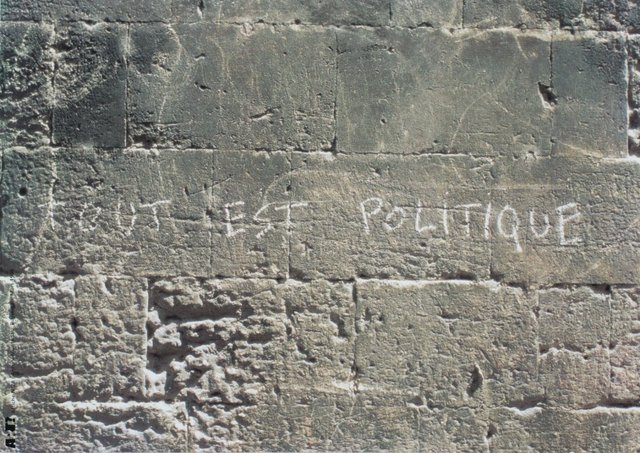
Photo of the text TOUT EST POLITIQUE in crayon on a wall. Muntadas discovered the text on a wall in the South of France (Arles), during the exposition Rencontres de la photographie (1997). Although the posters shows us a sentence that we can understand, Muntadas wants us to read not only the words, but also the image, since the placement of the sentence has a meaning as well, and surely a history.
These posters form a triptych of three, all stating Tout va bien, in a bold letter, on a coloured background. As the sentence is written in French, the three posters are made to the colours of the french flag being red, white and blue. The blue poster represent the town where the community lives, white is for the parliament and red to indicate the protest of the people.
M HKA participated in the ongoing project On Translation: Warning, and put together a small commitee to talk about the best Flemish translation of the sentence "Warning: Perception requires involvement". We decided on "Waarschuwing: Kijken verlangt engagement" and agreed with Antoni Muntadas to spread a sticker version during the exhibition "Antoni - Muntadas - Alles is politiek".